2026-07-12 · 3 min read
Why peptides ship by the gram: dosage, potency and pack maths
Cosmetic peptides work at fractions of a percent; here is what that means for pack sizes, batch economics and how far one small pack really goes.
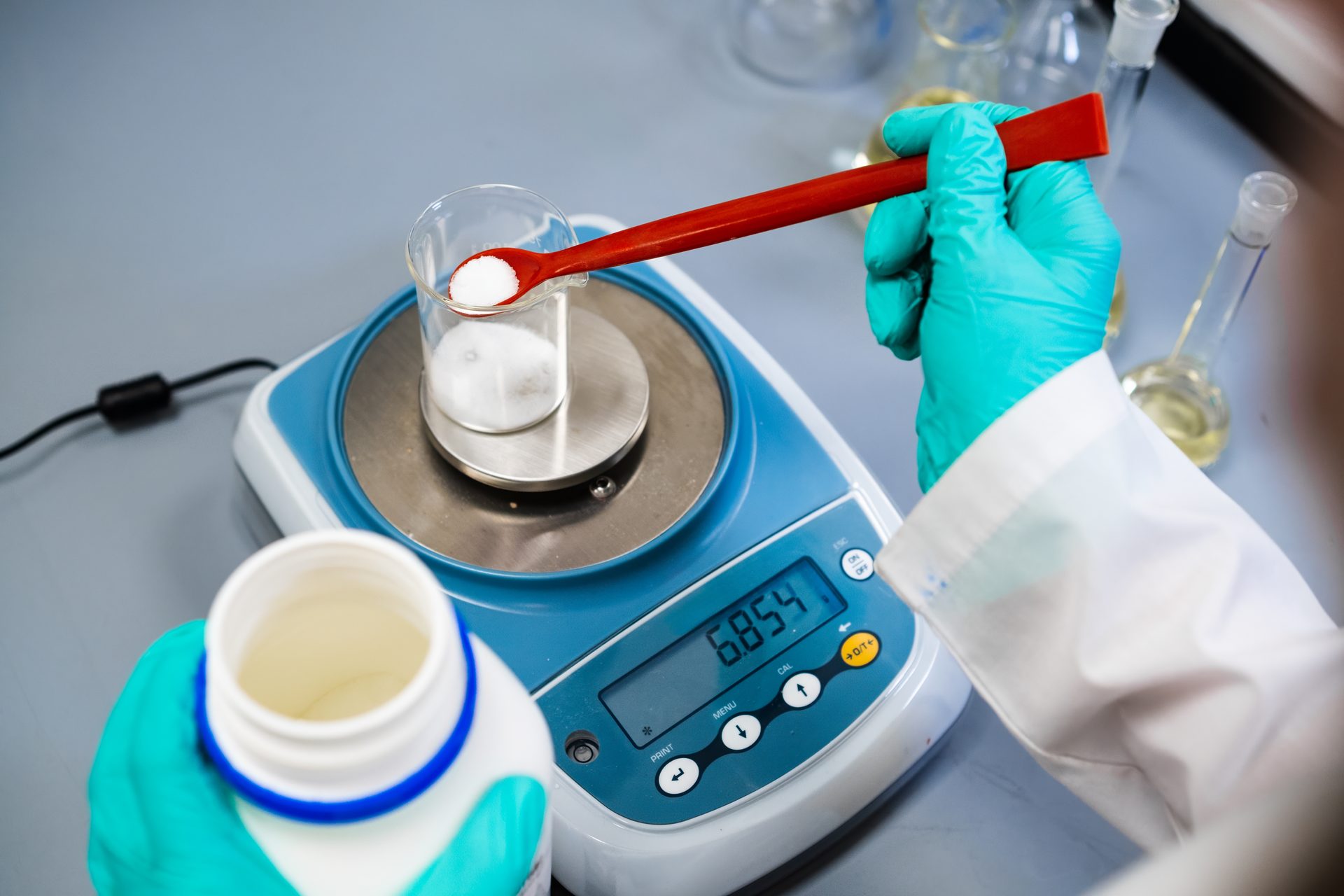
Most raw materials in this industry move on pallets: 25 kg drums, 300 kg minimums, a forklift at the loading dock. Peptides are the exception. Across the VinPep range, packs start at 0.1 kg (one hundred grams), small enough to post. That is not a supply quirk or a sampling courtesy. It is what potency looks like once you turn it into logistics.
Potency doesn't need volume
Cosmetic peptides are short amino-acid chains, and they work at low levels. Signal peptides, such as palmitoyl pentapeptide-4, prompt skin cells to do something specific, for example build collagen. Carrier peptides, such as copper tripeptide-1, deliver a trace element to skin. Neither works by being present in bulk, so the use level is a fraction of what an emollient or a humectant needs. Where an oil phase is measured in whole percentage points, a peptide is measured in tenths.
Take VinPep-Cu, INCI Copper Tripeptide-1, a carrier peptide and one of the range's best-known actives. Its typical use level is 0.1–1% of the finished formula, and it ships in that 100 g pack. Those two numbers together are what make the economics of peptides so different from everything else on the shelf, so it is worth doing the arithmetic properly.
The pack maths
The finished formula a pack can treat is the pack weight divided by the use level (as a decimal). For a 100 g pack of VinPep-Cu:
- At 1% (the top of the range): 100 g ÷ 0.01 = 10 kg of finished product.
- At 0.5% (a common working dose): 100 g ÷ 0.005 = 20 kg of finished product.
- At 0.1% (the bottom of the range): 100 g ÷ 0.001 = 100 kg of finished product.
So a single hundred-gram pack, depending only on where in its own dosage window you formulate, activates somewhere between 10 and 100 kg of serum. At the mid-point that is 20 kg, on the order of 650 thirty-millilitre retail bottles from one pack that fits in an envelope.
The same arithmetic runs across the VinPep range. Dosage windows and pack sizes, from the datasheets:
What that means for a buyer
Two things follow, and both cut against the instinct to over-order.
Small packs are the right unit, not a compromise. With a material this potent, a "big" order is still a small parcel. Buying peptides by the drum ties up capital in an active you will dose in tenths of a percent, and peptides are not the ingredients you want ageing in a warehouse. Order to the batch, and let the pack maths above tell you how little that is.
Cost per kilo of ingredient is the wrong lens. A peptide's headline price looks steep against a commodity emollient, but you are not buying it by the formula-kilo. The number that matters is cost per kilo of finished product: the pack price spread across the 10–100 kg it can treat. Run that division and the "expensive" active is often a rounding error in the cost of the serum it defines.
So the sourcing habit runs the other way from bulk ingredients: order to the batch and dose precisely. One 100 g pack covers 10–100 kg of finished product.
See the peptide range for use levels and pack sizes on each datasheet, or talk to a specialist to size a pack to your batch.
Frequently asked
Why are peptides sold in grams rather than kilos?
Because they are used at fractions of a percent. A quantity that would be a rounding error for an emollient is a full development programme's worth of a peptide.
Are peptides expensive to formulate with?
The per-kilo price is high, but that is the wrong unit to judge by. What matters is cost-in-use (the cost of the peptide in one finished unit at its actual use level), and on that basis peptides are often comparable to other premium actives.
How much peptide do I need for a trial?
Far less than for most raw materials. Work back from the use level and the batch size rather than ordering by habit; gram-scale packs generally cover bench work and a pilot batch.